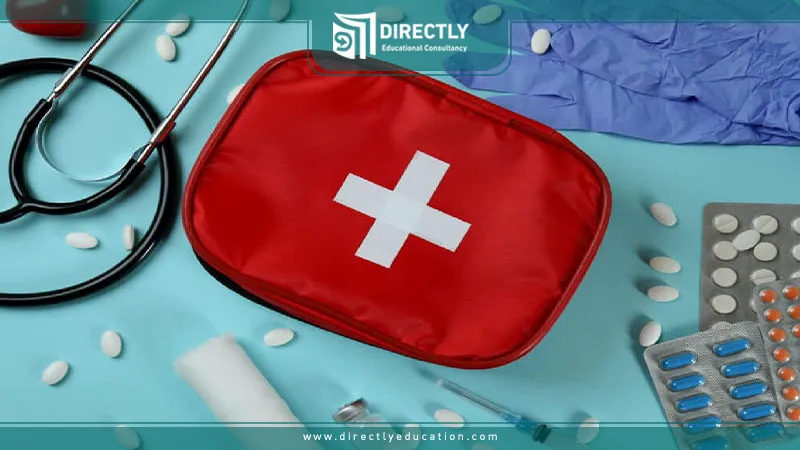
The right decision during the first few minutes of an emergency can make a real difference in a patient’s life, and this is where the responsibility of a trained paramedic begins. The First and Emergency Aid program at Hasan Kalyoncu University is a two-year vocational program that combines medical knowledge with training related to pre-hospital patient care.
In this Directly guide, we explain the nature of the program, courses, training, tuition fees, admission requirements, and career opportunities after graduation. If you are planning to study paramedicine in Turkey, contact us to review your profile and learn the application steps that suit your situation.
What Is the First and Emergency Aid Program at Hasan Kalyoncu University?
The İlk ve Acil Yardım program at Hasan Kalyoncu University is an associate degree program, or Önlisans, offered within the university’s Vocational School. It prepares students to work in the field of emergency medical care before patients reach the hospital.
Students learn how to assess a patient’s condition, provide basic and advanced life support, respond to cases requiring rapid intervention, and transport patients safely in ambulances. Graduates are qualified to work as Paramedics in emergency care fields related to their specialization.
The program focuses on preparing paramedics who can make decisions under time pressure, understand their professional responsibilities, and manage patient care from the moment the emergency team arrives at the scene until the patient is transported to a healthcare facility.
Why Choose to Study Paramedicine at Hasan Kalyoncu University?
Studying paramedicine at Hasan Kalyoncu University combines medical courses with professional applications related to paramedic work, so the program is not limited to theoretical study.
The academic curriculum includes courses in emergency care, life support, and professional practice, along with summer training in a healthcare work environment.
Some points worth considering when comparing this program with others include:
- The program takes two years, providing students with a shorter path to a professional qualification.
- Students take courses directly related to emergency cases and fieldwork.
- The curriculum includes professional practice during the second year.
- Students complete 30 working days of summer training after the first year in clinical institutions and 112 emergency medical teams.
- The program page requires students to obtain a driving license before the beginning of the third semester.
- The program opens career paths in ambulance and emergency services after graduation, subject to applicable employment and licensing requirements.
These details are important for students looking for a health-related program connected to fieldwork and direct interaction with emergency cases.
Read also: What Is Hasan Kalyoncu University’s Ranking Locally and Globally?

Duration and Language of First and Emergency Aid at Hasan Kalyoncu University
The First and Emergency Aid program at Hasan Kalyoncu University takes two years, divided into four academic semesters, and leads to an associate degree, or Önlisans.
The program is taught in Turkish, according to the university’s current 2026 program list.
International students need to prove their Turkish language proficiency. Students who do not meet the required language level must complete a preparatory language pathway until they reach the level required for study.
The curriculum also includes summer training and professional practice alongside academic courses throughout the two years.
What Do You Study in the First and Emergency Aid Program?
The First and Emergency Aid curriculum at Hasan Kalyoncu University is designed around the skills paramedics need when dealing with patients or injured individuals outside the hospital.
Students begin with the fundamentals of anatomy, physiology, and emergency care, then move on to pharmacology, life support, professional practice, and more complex medical cases.
Some of the main First and Emergency Aid courses include:
| Course | What Does the Student Learn? |
| Anatomy | Structure of the human body and vital systems |
| Physiology | How body systems function |
| Emergency Patient Care I, II and III | Patient assessment and emergency intervention |
| Emergency Health Services I and II | Organization of emergency services and operational procedures |
| Pharmacology | Fundamentals of medications related to medical care |
| Advanced Life Support Applications I and II | Managing critical cases and resuscitation |
| Professional Practice I and II | Practical skills related to paramedic work |
| Professional Ethics and Communication | Communication with patients and the medical team |
| EKG Management | Working with electrocardiography as part of elective courses |
| Disaster Information | Understanding health responses during disasters and emergencies |
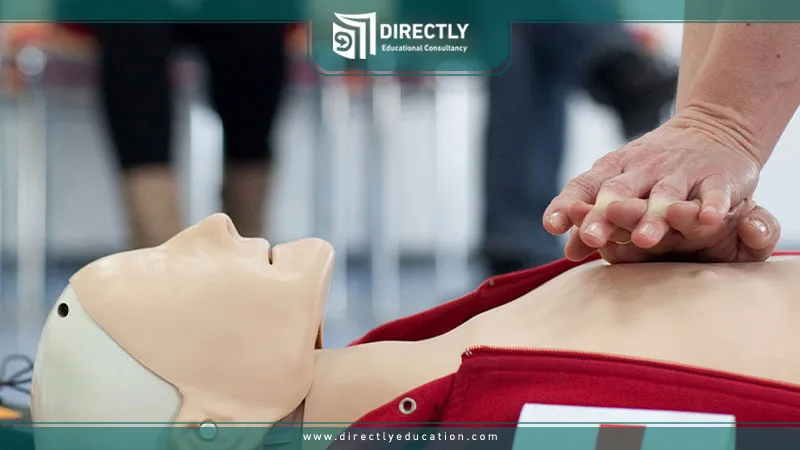
Emergency care courses cover topics such as airway management, cardiopulmonary resuscitation, oxygen therapy, choking, and assessment of the respiratory, cardiovascular, and nervous systems, in addition to various emergency medical conditions.
Read also: Hasan Kalyoncu University Programs and Admission Requirements
Practical Training in the First and Emergency Aid Program
Practical training has a significant role in the program.
The second year includes Professional Practice I and II with practical training hours. In the fourth semester, the curriculum allocates 12 practical hours per week to the second professional practice course.
Students also complete 30 working days of summer training after the first year in clinical institutions and 112 ambulance units.
This stage helps students move from understanding emergency procedures in the classroom to working within a real healthcare environment and meeting the requirements of a medical team.
First and Emergency Aid Admission Requirements at Hasan Kalyoncu University
The university accepts international students into the First and Emergency Aid program as part of its associate degree programs and allocated 10 international student places for the program in the 2026–2027 admission announcement.
Students must meet international admission requirements and prepare the required documents before submitting their applications.
The main application requirements include:
- Holding a high school diploma or being in the final year of high school.
- Being eligible to apply under the international student category according to admission regulations.
- Submitting a high school diploma and transcript.
- Providing a valid passport and a recent personal photograph.
- Providing a Turkish language proficiency certificate, if available.
- Meeting the requirements of accepted examinations if the student uses them as part of the application file.
- Completing original document, translation, and certification requirements during final registration.
For 2026, the university publishes a minimum accepted score of 200 out of 500 in TR-YÖS, or 1000 out of 1600 in SAT, with at least 500 out of 800 in the Mathematics section.
Read also: Why Choose to Study at Hasan Kalyoncu University?
First and Emergency Aid Tuition Fees at Hasan Kalyoncu University 2026
The tuition fee schedule for the 2026–2027 academic year lists First Aid and Emergency under the Vocational School with an annual tuition fee of TRY 480,000 without a scholarship, while the fee under the 25% discount category is TRY 360,000.
The program also appears among fully funded places in the domestic admission table.
| Tuition Category | Annual Tuition 2026–2027 |
| Without Scholarship | TRY 480,000 |
| 25% Discount | TRY 360,000 |
| Full Scholarship | No tuition fees |
Note for international students: The international admission page does not publish a separate price for the program in the 2026–2027 announcement. The international student page also states that tuition fees and scholarships vary according to the program and admission cycle.
Therefore, students should rely on the amount stated in their final admission letter before transferring any payment.
Applying for First and Emergency Aid at Hasan Kalyoncu University
Applying for the First and Emergency Aid program at Hasan Kalyoncu University begins with submitting an international student application online and selecting First and Emergency Aid – İlk ve Acil Yardım from the Vocational School programs.
The announced international application period for the 2026–2027 academic year continues until November 30, 2026.
Application steps:
- Choose the First and Emergency Aid – İlk ve Acil Yardım program.
- Prepare your passport, high school diploma, transcript, and personal photograph.
- Add your language certificate or academic examination result if it is part of your application file.
- Upload the documents through the online application system.
- Follow the confirmation that your application has been received and the evaluation result.
- After admission, prepare the original documents, translations, and high school diploma equivalency.
- Pay the tuition amount stated in your admission letter and complete final registration.
Read also: Required Documents for Hasan Kalyoncu University 2026
Apply to Hasan Kalyoncu University Through Directly
Choosing a health-related program requires confirming the admission requirements, language of instruction, and cost before submitting your application.
At Directly, we review your academic file and help you prepare the application steps for the First and Emergency Aid program according to the current admission requirements.
- We review your high school diploma and transcript.
- We check whether your profile is eligible for international student admission.
- We explain the Turkish language requirements.
- We review your documents before uploading the university application.
- We help you follow the admission and final registration procedures.
- We explain the tuition amount stated in your admission offer before you complete payment.
Contact the Directly team via WhatsApp now and send us your nationality, high school diploma, and transcript. We will explain the steps for applying to the Paramedic program at Hasan Kalyoncu University.