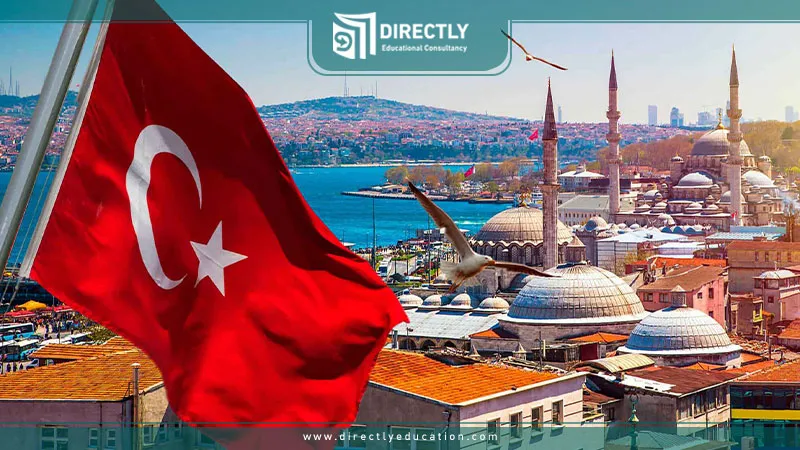
Choosing a university in Turkey requires a clear understanding of admission requirements, tuition costs, and the language of instruction before submitting any application. International students can choose between public and private foundation universities, with programs ranging from Medicine and Engineering to Business Administration and Social Sciences, taught in Turkish or English.
At Directly, we have gathered the most important information about studying in Turkey in 2026, including admission requirements, tuition fees, universities, required documents, scholarships, and registration steps. If you are planning to start your studies in Turkey, you can contact our team to compare universities that match your grade, preferred major, and budget.
Why Study in Turkey as an International Student?
Turkey offers international students a wide range of choices in terms of universities, majors, and languages of instruction. Students can choose a public university with highly competitive admission or a private university that offers a more flexible admission process and accepts high school diplomas for many programs.
Students also study in a diverse university environment with different nationalities and can choose between Istanbul, Ankara, and other cities depending on the university and their budget. English-taught programs are available in Medicine, Engineering, Business Administration, Health Sciences, Social Sciences, and other fields at many universities.
What Are the Advantages of Studying in Turkey?
The advantages of studying in Turkey are mainly linked to the variety of available options, allowing each student to build a study plan based on their academic and financial situation.
- Public and private universities offering a wide range of academic majors.
- Bachelor’s, master’s, and PhD programs taught in English.
- Extensive options in Medicine, Dentistry, Engineering, and Business Administration.
- Direct admission with a high school diploma at many private universities.
- Different tuition levels suitable for various budgets.
- Government scholarships, university scholarships, and discounts.
- Different cities to choose from based on accommodation and living costs.
- Turkish universities with a strong presence in international rankings.
- Easy access to Turkey from countries in the Middle East and North Africa.
- Availability of student dormitories and shared apartments near universities.
What Are the Requirements to Study in Turkey in 2026?
There is no single set of admission requirements applied by all Turkish universities to international students. Each university determines its own criteria based on its type, the chosen program, and the student’s qualifications.
Requirement | Public Universities | Private Universities |
High School Diploma | Required | Required |
Transcript | Required | Required |
TR-YÖS | Required or accepted alongside academic alternatives by public universities according to their rules | Not required at many private universities |
High School Grade | Varies by university and major | Varies by program, with higher requirements for Medicine |
Language Certificate | According to the program language | According to the program language |
Passport | Required | Required |
High School Equivalency | Required at final registration depending on the student’s case and university | Required at final registration for certain universities and programs according to regulations |
Public universities may accept TR-YÖS results or other qualifications and examinations specified in their international student admission requirements. Private universities, on the other hand, allow direct applications with a high school diploma for many programs.
Meeting the minimum grade does not automatically guarantee admission. Available seats and the strength of the application also affect the final decision, especially for Medicine, Dentistry, and public universities.

How Much Does It Cost to Study in Turkey in 2026?
The cost of studying in Turkey in 2026 varies between public and private universities. Medical programs are also generally more expensive than Engineering, Business, and Social Sciences.
Study Type | Indicative Annual Tuition Range for 2026 |
Public Universities | Each university determines international student tuition annually |
Non-Medical Bachelor’s at Private Universities | Around $4,000–$12,000 |
Medicine at Private Universities | Around $18,000–$44,000 |
Dentistry at Private Universities | Around $16,000–$36,000 |
Pharmacy | Around $10,000–$18,000 at several universities |
English Preparatory Year | Around $4,400–$8,000 depending on the university |
For example, non-medical bachelor’s programs at Üsküdar University start from around $4,200 per year, while some Engineering programs at other universities may cost $9,000 or $12,000. Medicine tuition starts from around $18,000 at some universities and can reach $44,000 for other medical programs.
Best Universities in Turkey for International Students
Choosing the best university in Turkey depends on the student’s intended major, as a university that is strong in Engineering may not be the same choice for a Medicine or Business Administration student.
University | Type | Notable Fields |
Middle East Technical University – METU | Public | Engineering and Sciences |
Istanbul Technical University – ITU | Public | Engineering, Architecture, and Technology |
Boğaziçi University | Public | Engineering, Business, and Sciences |
Hacettepe University | Public | Medicine and Health Sciences |
Koç University | Private Foundation | Medicine, Engineering, and Business |
Sabancı University | Private Foundation | Engineering, Business, and Social Sciences |
Bilkent University | Private Foundation | Engineering, Business, and Sciences |
Bahçeşehir University | Private Foundation | Engineering, Business, and Medicine |
Istanbul Medipol University | Private Foundation | Medicine, Dentistry, and Pharmacy |
Istinye University | Private Foundation | Medicine, Health Sciences, and Engineering |
Üsküdar University | Private Foundation | Psychology, Health Sciences, and Engineering |
What Are the Best Majors to Study in Turkey?
Turkish universities offer a wide range of academic programs. Choosing a major should be connected to the student’s career plan and the country where they intend to work after graduation.
Field | Majors Worth Comparing |
Health Sciences | Medicine, Dentistry, Pharmacy, Nursing, Physiotherapy |
Engineering & Technology | Computer Engineering, Software Engineering, Artificial Intelligence, Electrical and Electronics Engineering, Industrial Engineering |
Business | Business Administration, Economics, Finance, International Trade |
Architecture & Design | Architecture, Interior Architecture, Industrial Design |
Humanities | Psychology, International Relations, Political Science |
Media & Communication | New Media, Public Relations, Cinema and Television |
Medicine and Engineering remain among the most popular fields for international students, while Software Engineering, Artificial Intelligence, and Information Systems have seen clear growth in university offerings in recent years.

What Documents Are Required to Study in Turkey?
At many universities, the initial application starts with a simple online file. Students then need to submit original or certified documents when completing final registration.
- High school diploma or temporary graduation certificate.
- High school transcript.
- Valid passport.
- Personal photo.
- Translation of the diploma and transcript if issued in a language not accepted by the university.
- TR-YÖS, SAT, or another international qualification when required.
- Turkish or English language certificate, if available.
- Admission letter at the registration stage.
- Tuition payment or reservation fee receipt at private universities.
- High school diploma equivalency when required for final registration.
Some universities may request additional documents depending on the program or the student’s nationality, so the university’s application requirements should always be reviewed before submitting the file.
Main Scholarships in Turkey for 2026
The Türkiye Scholarships government program is one of the main funding opportunities available to international students. Applications for the general 2026 scholarship were open from January 10 to February 20, 2026, covering bachelor’s, master’s, and PhD programs.
The main government scholarship includes:
- Tuition fees.
- University admission and placement.
- Monthly stipend.
- Accommodation according to the scholarship system.
- Health insurance.
- One year of Turkish language study.
- A travel ticket at the beginning of the study period and after graduation according to the program.
Other opportunities are also available, including:
- Merit scholarships offered by private universities.
- Full-payment discounts.
- Sibling discounts at some universities.
- Academic scholarships awarded after enrollment for students who achieve a high GPA.
- Türkiye Scholarships – IsDB Program for eligible countries and applicant categories.
- Success Scholarship for students already studying in Turkey who demonstrate high academic performance.
We do not recommend building your study budget around an expected scholarship before receiving an official decision, especially because private university scholarships may vary from one semester to another.
How Does Directly Help You Study in Turkey?
If you have decided to study in Turkey and want to know which university best matches your grade, major, and budget, the Directly team can help you organize the admission process from the first step through final registration.
- Review your certificate and grade before applying.
- Identify universities that match your academic qualifications.
- Compare majors, tuition fees, and languages of instruction.
- Clarify whether TR-YÖS is required for your chosen university.
- Review available scholarships and discounts at the time of application.
- Prepare your admission file and review your documents.
- Submit your application and follow up on the result with the university.
- Explain reservation fees and payment procedures.
- Follow up on final registration after admission is issued.
Contact the Directly team via WhatsApp and send us your certificate, grade, and preferred major. We will help you compare universities and begin your study application process in Turkey.