

The Political Science and International Relations major at Ibn Haldun University gives you the chance to understand what happens behind the news, not just follow it.
Through this major, you study how relations between states are formed, why crises and conflicts emerge, how policies are made, and how balances of power change regionally and internationally.
The program helps you analyze events within their historical and political context and build an opinion based on evidence rather than quick impressions. Studying Political Science and International Relations in Istanbul at Ibn Haldun University stands out through an English-taught program, a comparative approach that does not limit knowledge to one perspective, and a clear focus on research, Turkish issues, regional affairs, and global developments.
Now prepare your favorite drink and keep reading with us to discover what makes Ibn Haldun University a choice worth adding to your list for studying Political Science and International Relations in Istanbul.
Overview of Ibn Haldun University in Turkey
Ibn Haldun University (İbn Haldun Üniversitesi) was established in 2015 and began accepting students in the 2017–2018 academic year as a foundation university located in Istanbul.
Ibn Haldun University focuses especially on humanities and social sciences, with clear attention to scientific research and multilingual education. It aims to prepare students who can understand and analyze contemporary issues from different perspectives.
This direction makes it a suitable environment for studying Political Science and International Relations, where students need to combine theoretical knowledge, research, and an understanding of historical, regional, and global contexts.
What Is the Political Science and International Relations Major at Ibn Haldun University?
The Political Science and International Relations major at Ibn Haldun University combines understanding politics within states with analyzing what happens between them on the international level. Political Science focuses on the state, power, political systems, government institutions, elections, and public policy making, while International Relations focuses on diplomacy, foreign policy, international organizations, conflicts, and cooperation between states.
The two fields meet in the program to give students a broader understanding of political events. Students do not only learn what happened, but also how to research its causes, compare political experiences, and analyze its results locally, regionally, and globally.
The program relies on political theories, historical and comparative analysis, research methods, and the study of contemporary issues, rather than memorizing news and political events separately. It also covers the main branches of the field, including political thought, comparative politics, Turkish politics, and international relations.
To help you understand the program before going into its courses and advantages, the following table summarizes the key information about studying Political Science in Turkey at Ibn Haldun University:
| Information | Details |
| Faculty | Faculty of Humanities and Social Sciences |
| Main degree | Bachelor’s |
| Bachelor’s duration | 4 years |
| Language of study | English |
| Number of bachelor’s courses | 45 courses |
| Credits | 135 credits |
| European credit system | 240 ECTS |
| Available academic degrees | Bachelor’s, Master’s, PhD |
The department belongs to the Faculty of Humanities and Social Sciences. The bachelor’s study plan requires completing 45 courses with a total of 135 academic credits and 240 ECTS, including common university courses, compulsory major courses, and a wide range of elective courses.
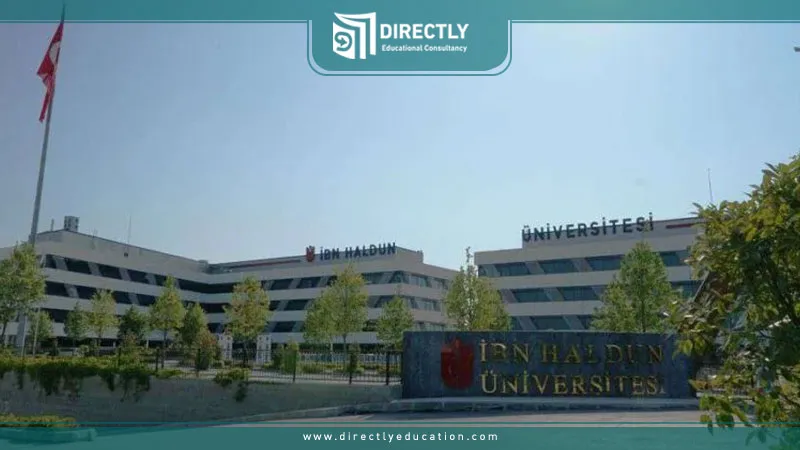
Where Is the Faculty of Political Science and International Relations at Ibn Haldun University Located?
The Faculty of Humanities and Social Sciences at Ibn Haldun University, which includes the Political Science and International Relations major, is located on the university campus in Başakşehir, Istanbul. The campus address is: Başak Neighborhood, Ordu Street, No. 3, Başakşehir, Istanbul 34480.
Being located within the university campus allows students to benefit from the library, research centers, and academic events related to politics, regional issues, and international affairs.
Why Study Political Science and International Relations at Ibn Haldun University?
Studying Political Science and International Relations at Ibn Haldun University gives you more than knowing theory names and following events. The program focuses on building your ability to compare, research, and analyze political problems within their historical, regional, and international contexts. The value of the program appears more clearly in the following elements:
A Comparative Curriculum That Goes Beyond One Political Perspective
The program studies Political Science and International Relations in Istanbul at Ibn Haldun University from a comparative perspective that does not limit the understanding of politics to one school of thought or one civilizational experience. It combines Western and non-Western contributions and analyzes local, regional, and global issues within an interconnected framework. This helps you compare concepts and political systems instead of treating them as fixed models.
This approach helps you ask deeper questions: Can the same theory explain events in both Europe and the Middle East? How do culture, history, and state structure affect political decisions? The university explains that the philosophy of its program is based on comparative education and benefiting from multiple civilizational accumulations in the study of politics and international relations.
Connecting Political Theories With Contemporary Issues
The program connects theoretical concepts with global transformations, so you understand how theories can be used to explain political reality, not only memorize them for exams.
The issues the department focuses on include:
- Transformations in the international system and shifts in balances of power.
- Turkish politics and foreign policy.
- Wars, humanitarian crises, and migration.
- International security and political conflicts.
- Social movements.
- Middle Eastern issues and neighboring regions.
- Global politics and conflict resolution.
This means that you will learn, for example, how to analyze a foreign policy decision, explain the reasons behind the continuation of a conflict, or compare how states respond to an international crisis, based on clear scientific and theoretical tools.
Research and Analytical Formation Beyond Lectures
The program gradually builds research skills through courses such as statistics, social statistics, research methods, and comparative politics, along with courses in international law, political economy, and diplomatic history. These courses help you read data, evaluate sources, formulate research questions, and distinguish between political opinion and evidence-based analysis.
The study plan also includes an elective internship course in Political Science and International Relations, giving students an opportunity to connect what they have learned with a real work or research environment. This is an important point if you are thinking about working in research centers, public institutions, or international organizations in the future.
Research Environment and Specialized Centers
The research environment surrounding the department allows students to follow political issues beyond the limits of university courses. The Department of Political Science and International Relations at Ibn Haldun University is connected to specialized centers, including:
- Center for Gulf Studies and Global Policies.
- Center for Conflict Analysis and Peace Studies.
- Haydar Aliyev Center for Eurasian Studies.
Multilingual Education and Wider Understanding of Sources
The bachelor’s stage is taught in English, within a university policy that also pays attention to developing Turkish and Arabic. This environment gives you an important advantage in a major that mainly depends on reading documents, studies, and political speeches issued in different countries and contexts.
Languages help you:
- Read international political studies in their original language.
- Access Turkish and Arabic sources without fully relying on translation.
- Understand terms and contexts that may lose part of their meaning when translated.
- Prepare for work in multicultural diplomatic, research, or international environments.
Read also: What Are the Advantages of Ibn Haldun University in Istanbul for International Students?
Political Science and International Relations Courses
Political Science and International Relations courses combine theoretical understanding with practical application. Therefore, students do not study politics as separate news items and scattered events; they learn how to understand and analyze it within a clear context. In general, the courses are divided into connected groups, including:
- Foundational and theoretical courses: To understand the state, power, political systems, and theories of international relations.
- Research and analytical courses: Such as statistics and research methods, to learn how to collect information, evaluate sources, and read data.
- Legal and diplomatic courses: Including constitutional and international law, diplomacy, and foreign policy.
- Economic and political courses: To understand the influence of economic interests on the decisions of states and relations between them.
- Applied and elective courses: Covering international security, conflicts, geopolitics, human rights, and internship opportunities related to the major.
Get your university admission for free by contacting us through Directly WhatsApp, and begin your study journey in Turkey with clear and safe steps.
Degrees and Fees for Political Science and International Relations at Ibn Haldun University
Ibn Haldun University offers Political Science and International Relations in three academic degrees, starting from the bachelor’s degree and reaching the PhD level. The content of each stage differs according to its purpose. The bachelor’s builds the knowledge and skills foundation, while the master’s and PhD focus on specialization and advanced research.
Here are the tuition fees and installments of Ibn Haldun University for Political Science and International Relations across all levels.
Bachelor’s in Political Science and International Relations at Ibn Haldun University
The Bachelor’s in Political Science and International Relations at Ibn Haldun University lasts four years and requires completing 240 ECTS. The program combines the study of politics within states and relations between them through core courses in political theory, international relations, comparative politics, and Turkish politics, along with a wide range of elective courses.
This flexibility gives students the opportunity to go deeper into a field closer to their interests, such as international security, conflicts, foreign policy, or geopolitics. The study plan also includes an elective internship course that helps students test their skills in a practical environment related to the major. The official plan consists of 45 courses, including common university, compulsory, and elective courses.
The bachelor’s tuition fee after discount, according to the currently available prices, is 5,000 USD.
Master’s in Political Science and International Relations
The Master’s in Political Science and International Relations at Ibn Haldun University is taught in English. It is a thesis-based program that combines theoretical knowledge with research training. It is suitable for bachelor’s graduates who want to specialize in a specific political field, work in research centers, organizations, and public institutions, or prepare for a later academic path.
The program lasts four semesters with a total of 128 ECTS. It includes research methodology in political science, an academic seminar, specialized elective courses, and then the preparation of the master’s thesis. Its courses cover topics such as political theory, theories of international relations, foreign policy, international security, political economy, and conflict analysis.
The tuition fee for the thesis-based master’s program after discount, according to the currently available prices, is 11,000 USD.
PhD in Political Science and International Relations
The PhD in Political Science and International Relations at Ibn Haldun University focuses on preparing researchers who can produce advanced political studies, not merely summarize existing theories. The program is taught in English and includes research methods and publication ethics, political theory, theories of international relations, comparative politics, and advanced courses in international security, political economy, and regional policies.
After the coursework stage, PhD students pass the qualifying exam, then prepare the dissertation proposal and move on to specialized research and academic writing. Therefore, the program suits those who plan to work in universities, research centers, policy analysis, or institutions that require advanced research expertise. The plan for students joining after a master’s degree consists of 240 ECTS, while the plan differs for students joining directly after a bachelor’s degree.
Fees may change according to the academic year, study level, and available scholarships or discounts. Contact the Directly team through WhatsApp to know the updated fees, available scholarships, and the suitable steps to receive your admission to Ibn Haldun University.
Read also: PhD Programs at Ibn Haldun University in Istanbul and Admission Requirements
Future of Political Science and International Relations
The Political Science and International Relations major builds a set of skills that can be used in many sectors, but it does not automatically lead to one specific job like some professional majors. The graduate’s value in the job market does not come from knowing political events only, but from the ability to research, analyze information, understand interests and institutions, and write reports that help decision-makers make better decisions.
For this reason, two graduates from the same program may work in completely different fields. One may work in public policy analysis, while the other works in government relations or political media. The American Political Science Association confirms that graduates of the major work in sectors that include public administration, business, journalism, law, nonprofit organizations, research, and academia.
Career Fields for Political Science and International Relations Graduates
Career fields in Political Science and International Relations expand according to the skills students develop, the languages they master, and the experience they gain before graduation. The most prominent possible paths include:
- Ministries and government institutions: In report preparation, public policy support, international cooperation, and political affairs.
- Embassies and diplomatic missions: Within paths that usually depend on government employment conditions and diplomatic exams in each country.
- International and non-governmental organizations: In program management, research, proposal and report writing, advocacy, and partner relations.
- Research and studies centers: In roles such as research assistant, political researcher, or policy and regional affairs analyst.
- Political and geopolitical risk analysis: Helping companies and institutions understand the impact of wars, sanctions, elections, and regulatory changes on their work.
- Government relations and public affairs: Following legislation, building relations with public authorities, and analyzing the impact of government decisions.
- Political media and journalism: In research, editing, content and program preparation, fact-checking, and event analysis.
- Consulting and public policy analysis: By studying a specific problem, comparing alternatives, and writing actionable recommendations.
- Postgraduate studies and academic work: For those who want to specialize in research or university teaching.
Graduating with a bachelor’s degree does not mean that the direct job title will be “political scientist.” Some advanced research jobs require a master’s or PhD, while bachelor’s graduates can begin in supporting or entry-level roles in research, projects, public and government relations, nonprofit organizations, and media. The U.S. Bureau of Labor Statistics indicates that specialized professional work as a “researcher or political scientist” usually requires a master’s degree, while some entry-level opportunities are available for bachelor’s holders in government institutions, campaigns, and related sectors.
What Increases a Graduate’s Chances in the Job Market?
Graduates increase their chances when they turn what they have learned into practical evidence they can present to employers. Employers do not rely only on the name of the major. They want to know: Can you analyze an issue? Can you write a clear report? Can you use data and sources correctly?
Students can build a stronger profile through:
- Mastering English and an additional language: International and research work depends greatly on reading sources and communicating with multiple parties.
- Getting practical training early: Inside a government institution, organization, research center, or media outlet.
- Mastering report writing and policy briefs: So they can summarize a complex problem and present clear options and recommendations.
- Developing qualitative and quantitative research: Through interviews, document analysis, surveys, statistics, and data reading.
- Building a specific specialization: Such as Middle East policies, migration, security, energy, or the European Union, instead of staying at a general level.
- Preparing a portfolio: Including short analyses, research papers, policy briefs, and published articles, not only a CV.
- Following events methodically: By comparing sources and connecting events to their legal, economic, and historical background.
- Learning supporting tools: Such as Excel, basic data analysis, presentations, project management, and digital research tools.
These skills align with what employers are looking for more broadly. The Future of Jobs Report 2025 issued by the World Economic Forum explains that analytical thinking remains the core skill most in demand, with seven out of ten companies considering it an essential skill for workers.
This gives Political Science and International Relations graduates a real opportunity, provided they prove their analytical ability through research, reports, and practical experience, not by relying on the certificate alone.

Political Science and International Relations Admission Requirements at Ibn Haldun University
Political Science and International Relations admission requirements at Ibn Haldun University differ according to the study level and the student’s nationality. In general, they include the certificate of the previous stage, transcript, passport, personal photo, and proof of language proficiency when needed. Applying to a master’s or PhD program requires additional academic documents depending on the program, such as a CV, recommendation letters, or academic evaluation requirements.
To know the requirements in detail, you can refer to our guide about the conditions and documents needed to apply to Ibn Haldun University.
Language of Study for Political Science and International Relations at Ibn Haldun University
The bachelor’s stage is taught in English, with clear attention to multilingualism within the study plan. The requirements and courses include English, Turkish, and Arabic, in addition to other elective languages. This diversity helps students read political sources in their original languages and prepare for work in multicultural international and diplomatic environments.
Is Ibn Haldun University Suitable for You to Study Political Science?
Studying Political Science and International Relations at Ibn Haldun University suits you if you follow politics to understand the causes and results of events, not just to know the news. It also suits you if you enjoy reading, research, and discussion, and want to develop your ability to analyze issues, write reports, and deal with sources in different languages.
However, if you are looking for a major that depends on quick memorization, leads to one guaranteed job immediately after graduation, or does not require continuous reading and writing, this program may not be your best choice. Success in it requires real curiosity, patience in research, and readiness to develop languages and practical experience alongside study.
Read also: Ibn Haldun University Scholarship in Turkey for International Students: Requirements and Details
Get Your Free Admission to Ibn Haldun University With Directly
The right university decision does not begin with submitting an admission application, but with choosing a major that matches your interests and future goals. That is why our team at Directly helps you confirm whether the major suits you, review admission requirements, prepare and submit your file, and follow up on it, while explaining fees and available scholarships with full transparency.
Do not let hesitation delay your first step. Contact us through Directly WhatsApp and get a consultation that helps you make your decision and apply for free to Ibn Haldun University.


